
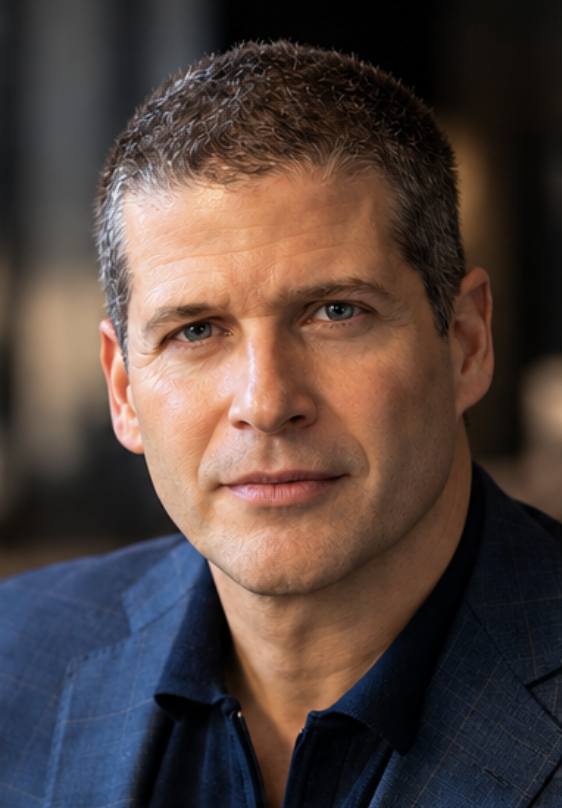
About Denes Ban
Built on both sides of the table.
For more than two decades, I have raised capital, deployed capital and helped others secure it.
I’ve personally raised more than $1 billion, invested in 100+ companies — including 15 unicorns — and helped companies and funds raise billions more from leading investors and institutional LPs.
That experience gave me an unusual perspective: I know what it feels like to need the capital, what investors need to believe before committing it, and what separates a strong underlying opportunity from a fundraise that actually moves.
Today, I bring that perspective to the companies, funds and institutions I work with.
Four chapters
I sometimes think about my career in four very different chapters.
Luke Skywalker
The Entrepreneur
Darth Vader
The Investor
Princess Leia
The Fundraiser
Yoda on Demand
Today
Luke Skywalker
Chapter I · The Entrepreneur
I learned fundraising from the side that hurts.
Before I became an investor, I was an entrepreneur trying to raise capital without the benefit of an established name or track record.
I remember the sleepless months. The cold emails. The networking events. The relentless follow-up. The unanswered messages.
Nine no’s for one yes. And sometimes the yes was only a meeting.
But it also taught me to find a way forward when nobody was waiting to open the door.
At Mobile World Congress, that meant finding a way to get our company in front of the CEO of T-Mobile.
At TechCrunch, we worked our way from thousands of applicants to the top 100, then the top 50, then the final 10 — and ultimately became one of the winners.
We built major partnerships with some of the largest players in the world before we had the track record that should have made those conversations possible.
Nobody was waiting for us. We had to earn attention before we could earn belief.
That’s where I first learned a lesson that has stayed with me ever since:
The quality of what you’ve built and your ability to make someone else believe in it are two different things.
Darth Vader
Chapter II · The Investor
Then I joined the Dark Side.
At OurCrowd, I crossed to the other side of the investment table.
Suddenly, I wasn’t the entrepreneur trying to create conviction.
I was the investor deciding whether I had it.
Over 11 years as Managing Partner, I evaluated thousands of opportunities and invested in more than 100 companies, including 15 that became unicorns.
And I learned to say no far more often than yes.
Sitting on that side of the table changes how you see fundraising.
You learn which evidence actually changes an investment decision.
Which claims investors discount.
Which questions expose the weakness behind an apparently strong story.
Why one opportunity creates urgency while another — sometimes equally good opportunity — doesn’t.
I learned to see the opportunity through the investor’s eyes.
Princess Leia
Chapter III · The Fundraiser
Raising capital became my craft.
At OurCrowd, I discovered something about myself fairly quickly.
I was a good investor.
But there was something I was exceptionally good at: raising capital.
We were building an investment platform with essentially no track record. Once again, I had to convince people to believe before all the proof existed.
We started with individual investors writing $10,000 and $50,000 checks. Then family offices. Corporations. Institutional investors. Eventually, some of the largest pools of capital in the world.
Over 11 years, I personally raised more than $1 billion, with individual raises eventually approaching $100 million.
I’ve experienced fundraising across almost the entire capital spectrum.
Different check sizes. Different decision processes. Different stakeholders. Different definitions of proof.
The investor changes. The fundamental challenge doesn’t: build enough conviction for someone to act.
But the billion dollars isn’t actually the most valuable part.
The most valuable part is what I learned getting there.
The learning curve
It wasn’t the 10,000 hours.
It was the 9,999 improvements.
Every investor conversation created another data point.
What created interest?
What created doubt?
Which evidence changed the conversation?
Why did one narrative work with a family office and fail with an institution?
Why did the investor take the next meeting — or decide not to?
And then came the important part:
Edit. Test. Reposition. Simplify. Repeat.
Thousands of conversations created thousands of iterations.
Over time, those iterations became pattern recognition.
What took me more than 20 years and thousands of fundraising decisions to learn is what my clients don’t have to learn from scratch.
Yoda on Demand
Chapter IV · Today
Today, that experience is yours to use.
I’ve helped clients raise billions — from health and technology companies raising from leading investors to venture funds raising capital from some of the world’s largest LPs.
Different companies. Different funds. Different investors. Different objections.
But after thousands of pitches, investor conversations and fundraising decisions, patterns emerge.
Today, I’m brought in when the decisions matter: to identify what’s preventing investors from moving, challenge assumptions that don’t survive investor scrutiny, and determine what needs to change before approaching the investors who matter most.
Internally, I think of it rather less formally:
Yoda on demand.
You still run the company.
You still raise the fund.
You still make the decisions.
But you don’t have to learn every lesson the expensive way.
Fundraisability™
The best opportunity doesn’t always win.
Having lived on both sides of the table, I began to see the same pattern repeatedly.
Excellent companies can struggle to raise. Strong funds can struggle to attract LP capital. And opportunities that aren’t necessarily better can create extraordinary investor momentum.
The quality of the underlying opportunity and an investor’s willingness to act are not the same thing.
There is a gap between them.
I call that gap Fundraisability™.
It is the idea behind everything we do at RAISE.
This isn’t about making a bad company look good. It’s about making sure investors see the strongest investable version of what you’ve actually built.
Explore the Fundraisability Score™Built from experience
$1B+
Personally raised
$5B+
Raised by clients
100+
Investments
15
Unicorn investments
11 years
Managing Partner, OurCrowd
20+ years
On both sides of the investment table











Today
Less writing.
Better judgment.
AI can analyze a deck, rewrite a slide and generate a hundred versions of a fundraising story in seconds.
That’s incredibly useful.
But fundraising isn’t ultimately a writing problem.
It’s a judgment problem.
Which evidence matters?
What’s actually holding investors back?
What should you change — and what should you leave alone?
When are you ready to approach the investor you don’t get a second chance with?
AI can row incredibly fast. After more than two decades of fundraising and investing, my job is knowing where to steer.
I’ve been the founder asking for the money.
I’ve been the investor deciding whether to give it.
I’ve been the fundraiser moving billions across the table.
Now I help you see the table from every side.